
BC Strata Depreciation Report Excel Template
8
Free download
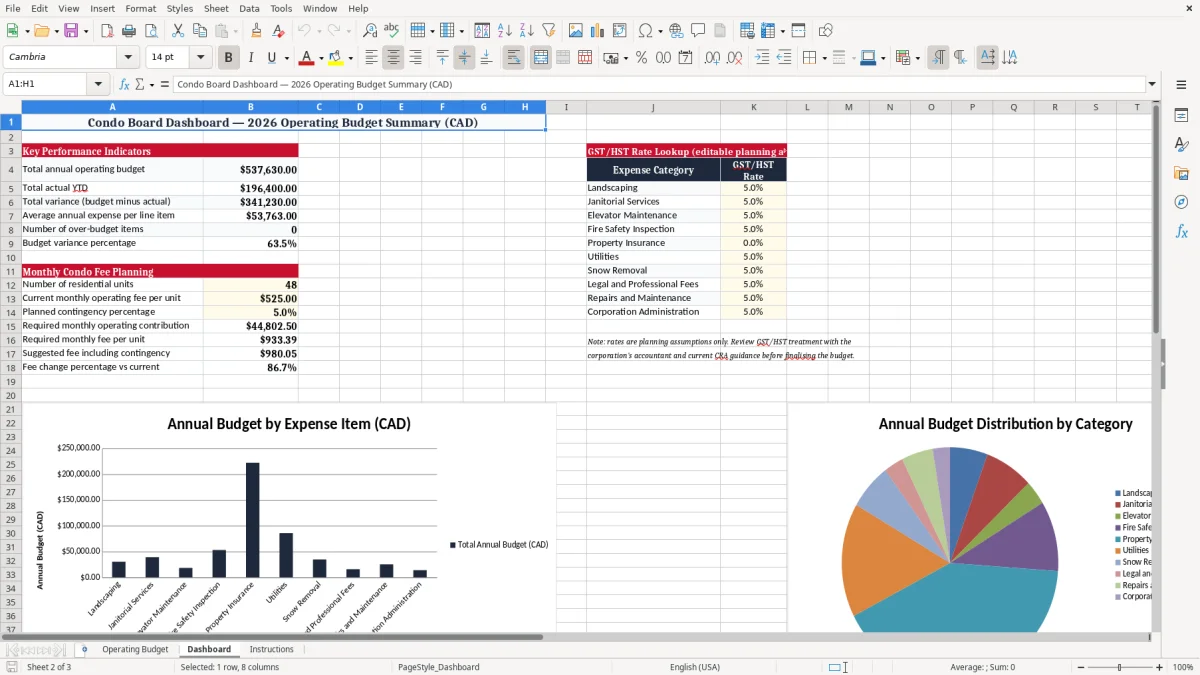
Plan Canadian condo expenses with an Excel budget template for GST/HST, vendors, actuals, variances, and CAD totals.
Download template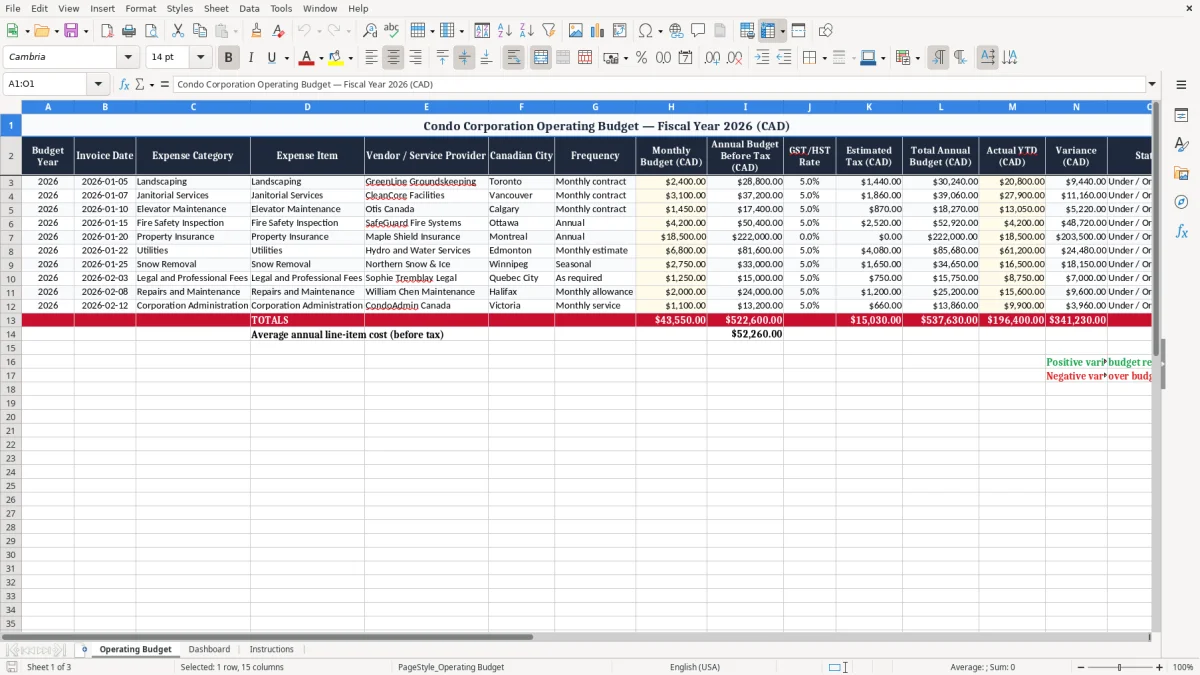
Create a clear annual operating budget for your Canadian condominium corporation with this practical Excel template. Track recurring expenses, invoice dates, vendors, Canadian cities, billing frequencies, GST/HST, actual year-to-date spending, variances, and budget status in one organized worksheet.
Sample lines cover common costs such as landscaping, janitorial services, elevator maintenance, fire safety inspections, property insurance, utilities, snow removal, and legal or professional fees. Condo boards, property managers, treasurers, and volunteer directors can customize the template for their building, fiscal year, contracts, and provincial tax requirements.
Begin by confirming the fiscal year and replacing the sample information with details for your condominium corporation. Review each expense category, then add or remove rows for contracts, utilities, repairs, insurance, administration, and other recurring costs. Enter the invoice date, vendor or service provider, Canadian city, and billing frequency for each line.
Add the expected monthly budget and annual budget before tax, taking care to distinguish monthly, seasonal, annual, and as-required expenses. Enter the applicable GST/HST rate and review the estimated tax and total annual budget fields. During the year, update actual year-to-date spending regularly and review each variance.
Use the status field to flag items that are on budget, under budget, over budget, awaiting information, or requiring board action. Keep supporting invoices, contracts, approvals, and budget assumptions with the workbook.
Before adopting the final budget, have it reviewed by the property manager, treasurer, accountant, or another qualified professional. Keep operating expenses separate from major capital projects and reserve fund contributions unless your corporation has a documented reason to combine them.
A condo board operating budget template gives directors and property managers a consistent way to plan the ordinary costs of running a condominium corporation. Without a structured worksheet, important expenses can be overlooked, recurring contracts may be recorded inconsistently, and actual spending can be difficult to compare with the approved plan.
An Excel template creates a shared starting point for reviewing landscaping, cleaning, utilities, insurance, elevator service, fire safety, snow removal, administration, and professional fees.
This Canada-focused template uses Canadian dollars and provides fields for GST/HST, vendors, Canadian cities, invoice dates, and service frequency. Those details help the board understand not only how much an expense may cost, but also when it is expected, who provides it, and whether the amount includes estimated tax. Monthly contracts, annual inspections, seasonal work, and as-required professional services can be listed together while remaining easy to review.
The template can support more transparent board discussions. Directors can examine assumptions, question significant changes, and identify expenses that need updated quotes or contract renewals.
Actual year-to-date figures provide an ongoing comparison rather than a year-end surprise. A status field can mark items requiring approval, investigation, or follow-up.
This template is a planning and monitoring tool, not a replacement for financial statements, a reserve fund study, professional accounting advice, or provincial condominium requirements. Use it alongside the corporation's approved budget process, supporting documents, and applicable legislation. A well-maintained worksheet can also make handovers between directors and managers easier because key assumptions, suppliers, and expected costs are recorded in one accessible place.
Those recorded supplier costs and expected payments should also line up with the sales tax remittance schedule so the corporation can compare accruals with tax amounts due.
Tax treatment is an important part of preparing a condominium operating budget in Canada. Service providers may charge GST, HST, or another applicable tax depending on the supplier, the service, and the province where the transaction occurs.
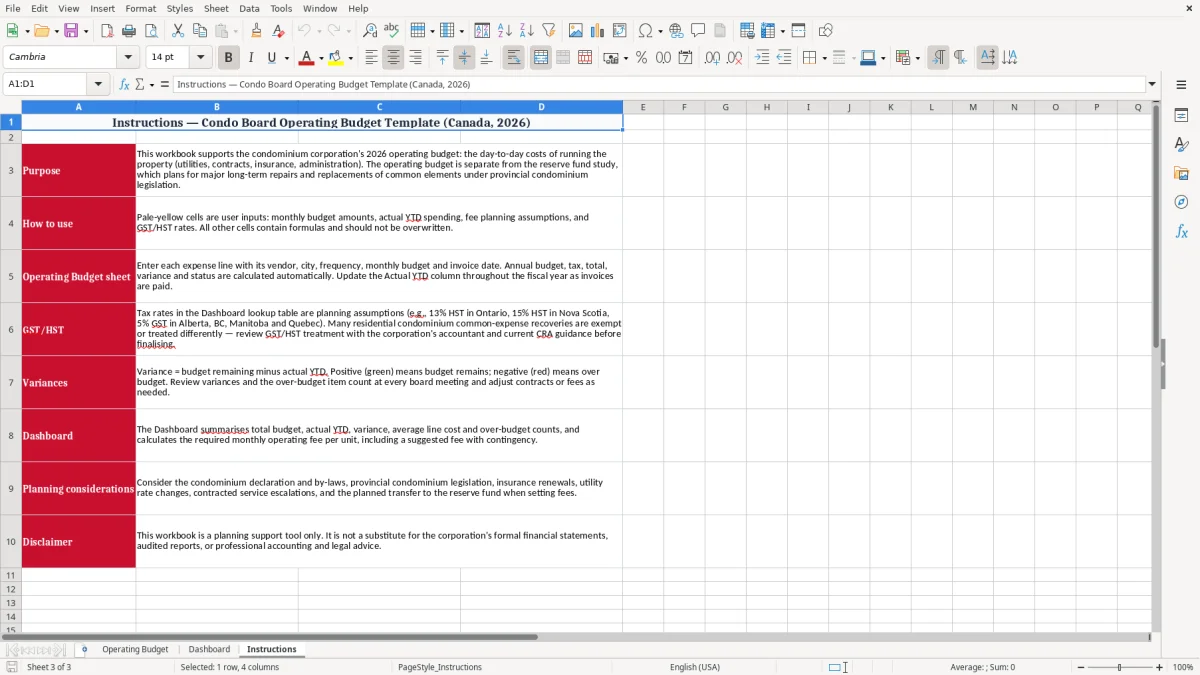
The template includes a GST/HST rate column, an estimated tax column, and a total annual budget field so the board can model expected costs before approval. Amounts should be entered consistently as either tax-exclusive or tax-inclusive according to the corporation's budgeting and accounting practice.
Provincial differences make it important to verify each line rather than apply one rate to every expense. Ontario generally uses HST, while Alberta generally has GST without a provincial sales tax. Other provinces and territories may have different rules, rates, rebates, or invoicing practices.
A supplier's invoice and advice from the corporation's accountant can help determine the correct treatment. Insurance, utilities, municipal charges, professional services, and maintenance contracts may not all be treated identically.
The spreadsheet's tax fields are designed for estimates and organization. They do not determine whether a condominium corporation can claim input tax credits, recover tax, or apply a rebate.
Those questions depend on the corporation's circumstances and current tax rules. If the board is uncertain, ask a qualified Canadian tax professional before adopting the final figures.
Review tax assumptions when contracts renew, suppliers change, or provincial rates change. Keep copies of quotes, invoices, and calculation notes with the budget records.
Clear documentation helps the board explain why a total changed and reduces the risk of comparing a tax-inclusive actual amount with a tax-exclusive budget amount. Consistent tax treatment also improves communication with owners and the corporation's bookkeeper.
Consistent tax treatment also improves communication with owners and the corporation's bookkeeper, and a team treasurer record can keep the supporting notes and totals aligned.
A condominium corporation's operating budget should reflect the recurring costs required to maintain shared property, provide services, and administer the corporation. Common categories include landscaping, janitorial services, utilities, elevator maintenance, fire safety inspections, property insurance, snow removal, waste collection, security, access control, repairs, and general maintenance.
Administrative lines may include management fees, bank charges, accounting, audit, legal, and other professional services.
The sample worksheet includes expenses such as landscaping, cleaning, elevator maintenance, fire safety, insurance, utilities, snow removal, and legal or professional fees. These examples can be adjusted to match the building's size, amenities, location, service agreements, and operating history. A high-rise condominium may need separate mechanical, security, and life-safety contracts, while a smaller townhouse corporation may have different shared-property obligations.
Record the frequency for every item because monthly, annual, seasonal, and as-required costs affect cash flow differently. An annual inspection should not be treated like a twelve-month contract, and seasonal snow removal may require an assumption based on expected service levels. Add notes or supporting records outside the core table when assumptions are complex.
Keep routine operating costs distinct from reserve fund contributions and major capital projects. Replacing a roof, elevator component, or building envelope may be planned through the reserve fund process rather than ordinary operations. Separating these purposes makes the annual operating requirement easier to understand and supports better communication with owners.
Review prior-year actuals, current contracts, inflation, utility trends, insurance renewals, and anticipated service changes before approving the next budget. Include contingencies only when they are clearly explained and approved.
An approved operating budget is most useful when it is monitored throughout the fiscal year. Enter actual year-to-date spending regularly so the board can compare financial performance with expectations.
The variance field provides a quick way to identify lines that are materially different from the plan, while the status field can indicate whether an item is on budget, under budget, over budget, awaiting an invoice, or requiring action.
Not every variance indicates a problem. A seasonal expense may be below budget early in the year and catch up later. An annual insurance premium may create a large one-time difference in the month it is paid.
Utilities can change because of weather, usage, rates, or billing timing. The board should consider the reason, timing, and expected full-year result before making a decision.
For significant differences, record the explanation and any corrective action. The property manager may need to request a quote, confirm a contract renewal, investigate an invoice, or revise the forecast.
Directors can also compare current spending with prior years and review whether a recurring budget assumption remains reasonable. Monitoring is especially important for insurance, utilities, maintenance contracts, repairs, and professional fees.
Use consistent definitions when calculating variance. Confirm whether the workbook compares annual budget with actual year-to-date amounts or uses a year-to-date budget comparison. Avoid mixing tax-inclusive and tax-exclusive figures.
The template supports organization, but the board should reconcile it with accounting records and financial statements. A monthly or quarterly review schedule can improve accountability and give unit owners clearer information about the corporation's financial position. Documenting explanations also creates a useful record for future budget preparation and board transitions.