
Canadian Bonspiel Draw Excel Template
0
Free download
Plan condo capital repairs, forecast reserve balances, and estimate contributions with this practical Canadian reserve fund Excel template.
Download template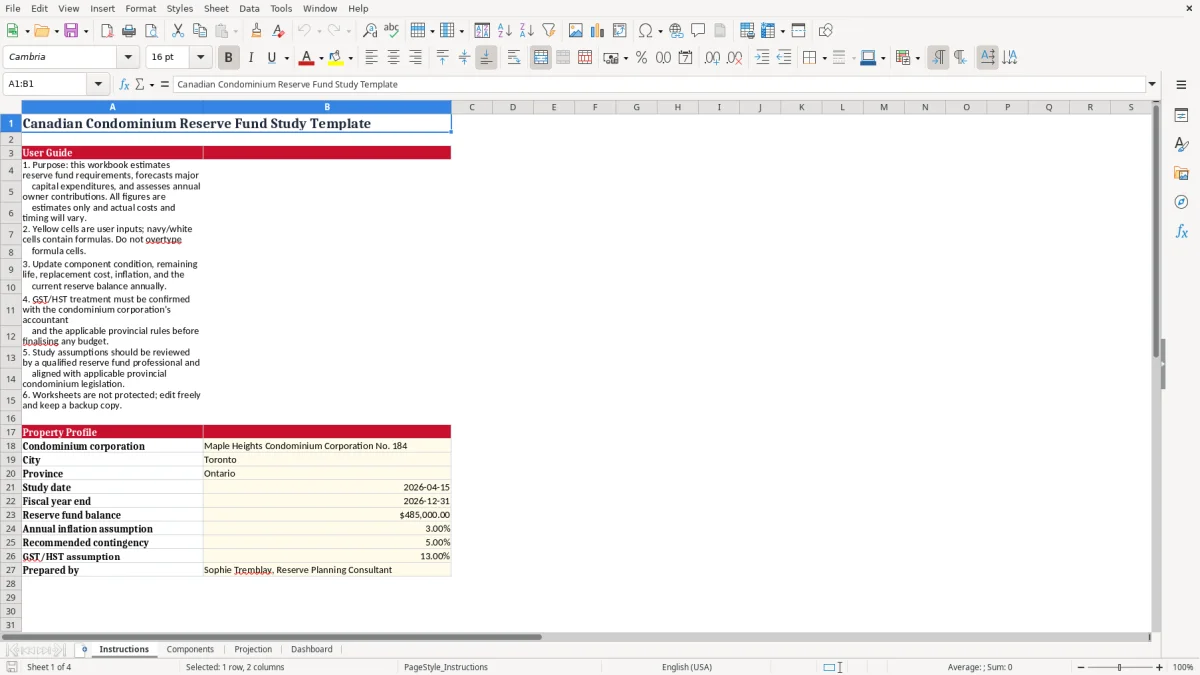
This Canadian condo reserve fund study Excel template helps condominium boards, property managers, treasurers, and finance committees organize long-term capital planning information. Use it to list common-element components, record condition and remaining life, estimate future replacement costs, forecast major expenditures, and review possible annual reserve fund contributions. The workbook is intended as a practical planning and budgeting aid.
It is not a professional reserve fund study, engineering report, legal opinion, or financial recommendation. Actual costs, timing, component performance, and funding requirements will vary. Review the assumptions with a qualified reserve fund professional, the corporation’s accountant, and advisers familiar with the applicable provincial or territorial requirements.
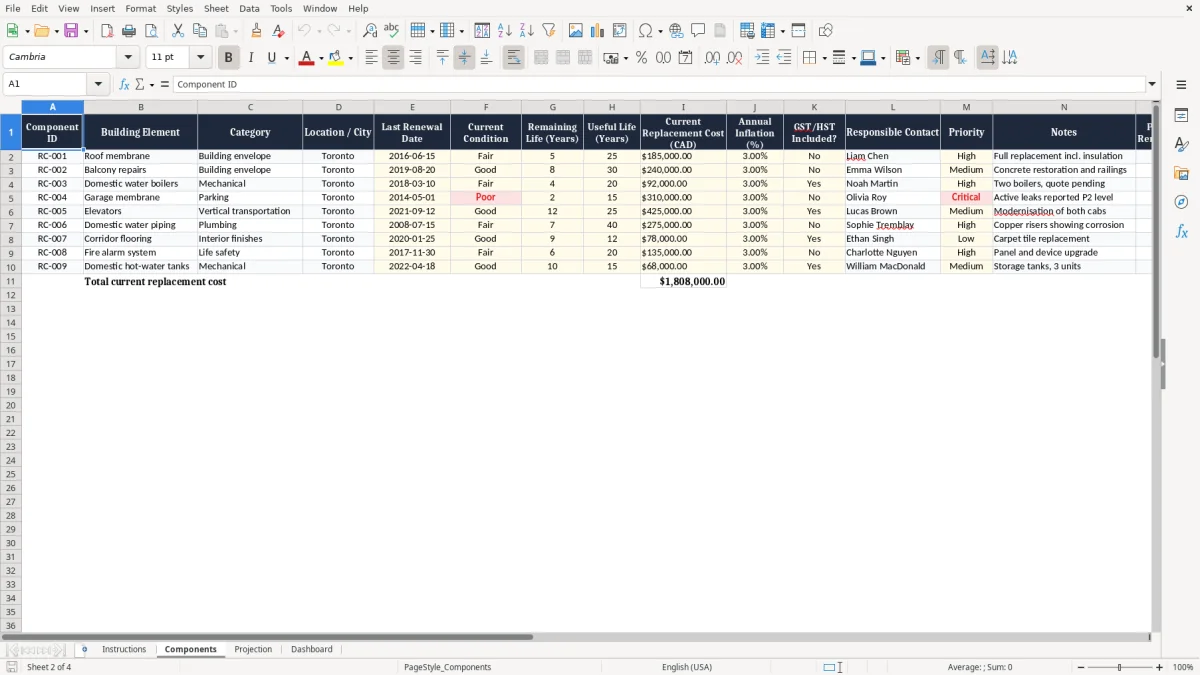
Begin by completing the property profile, including the condominium corporation name, location, study date, and number of units. Add each significant common-element component, such as roofing, elevators, balconies, windows, mechanical systems, parking structures, paving, or life-safety equipment. Enter the installation year or last replacement year, expected useful life, estimated remaining life, current condition, and current replacement cost.
Include suitable allowances for design, permits, project management, contingencies, taxes, and related work where appropriate. Review the inflation assumption and projected expenditure year for every component. Enter the current reserve fund balance and planned annual contributions, then review the forecast for unusually low or negative balances.
Update the workbook at least annually and whenever an inspection, quotation, major repair, replacement, or professional reserve fund study changes the assumptions. Yellow cells are intended for user inputs, while navy and white cells generally contain formulas or calculated outputs.
Keep a backup copy and retain supporting reports, invoices, quotations, inspection records, and board decisions. Before treating the results as the corporation’s formal funding plan, obtain professional and accounting advice and confirm the legislation, regulations, declaration, bylaws, rules, disclosure obligations, and reserve fund requirements applicable in the condominium’s province or territory.
A condo reserve fund study is a long-term assessment of a condominium corporation’s major repair and replacement obligations. It normally considers common elements such as roofs, windows, balconies, parking garages, elevators, mechanical equipment, electrical systems, paving, fire protection, and interior common-area finishes. The study estimates when components may require work, what that work could cost, and how much money the corporation may need to collect over time.
This Excel template provides a practical framework for organizing those assumptions and creating a preliminary funding forecast. It can help a board understand how current contributions compare with anticipated capital expenditures. By showing component timing, estimated costs, and projected reserve balances, the workbook can make future financial pressures easier to discuss before urgent repairs arise.
The template does not replace a professional study. A qualified reserve fund professional may inspect the property, assess component condition, consider construction standards, evaluate risks, and develop a funding recommendation that reflects the corporation’s circumstances. The workbook also does not determine whether a building is structurally safe or compliant with building codes.
Use the template as a planning aid before a professional engagement, as an annual update tool, or as a way to organize records for board and owner discussions. Keep all assumptions transparent and document the source of significant cost, life, and timing estimates. This makes later updates more consistent and helps distinguish verified information from preliminary estimates.
Canadian condominium corporations face changing construction costs, aging building systems, weather exposure, maintenance requirements, and different legal obligations across provinces and territories. A reserve fund forecast helps the board connect these physical responsibilities with a realistic financial plan.
Without organized planning, a corporation may discover that regular contributions are insufficient shortly before a large roof, elevator, garage, or envelope project becomes necessary.
A structured workbook makes it easier to review the condition and expected life of each major component. The board can compare several assumptions, such as different inflation rates, project years, contribution levels, or starting balances. This does not predict the future with certainty, but it creates a documented basis for discussion and helps identify which assumptions require professional review.
Good reserve fund planning can also improve communication with owners. Owners can see that contributions are connected to identifiable common-element responsibilities rather than being selected without explanation. Clear records may support annual budgeting, long-term capital planning, and preparation for a formal reserve fund study or update.
Provincial and territorial requirements differ. Confirm whether a formal study, periodic update, qualified reviewer, disclosure process, or prescribed funding approach applies to the corporation.
The corporation should also ask its accountant about GST or HST treatment and maintain records supporting the estimates entered in the workbook. A local professional can help interpret requirements and identify omissions.
A useful reserve fund inventory should cover significant common elements that may require major repair, renewal, or replacement. The exact list depends on the property’s age, design, construction, location, maintenance history, and declaration. Typical components include roofing membranes and assemblies, exterior cladding, masonry, caulking, windows, exterior doors, balconies, railings, parking garage structures, garage membranes, roads, sidewalks, curbs, underground services, fencing, gates, and landscaping features.
Building systems may include elevators and modernization work, boilers, pumps, air-handling equipment, heating and cooling equipment, domestic water systems, plumbing infrastructure, electrical distribution, emergency generators, fire alarms, sprinkler systems, access controls, security equipment, and ventilation systems. Interior common elements can include lobby finishes, corridors, amenity areas, flooring, cabinetry, lighting, and shared laundry or recreation equipment.
For each component, record a clear description and location, the installation or last replacement year, expected useful life, estimated remaining life, current condition, and current replacement cost. Where work is likely to occur in stages, separate the component into logical phases. Avoid relying on a single broad allowance when several systems have different timing, condition, or cost profiles.
Use maintenance records, prior studies, inspection reports, warranties, invoices, contractor quotations, and management knowledge to support the entries. A professional should review uncertain components, especially those involving structural systems, water penetration, life safety, or costly building-envelope work. Keep notes explaining assumptions and update them when new evidence becomes available.
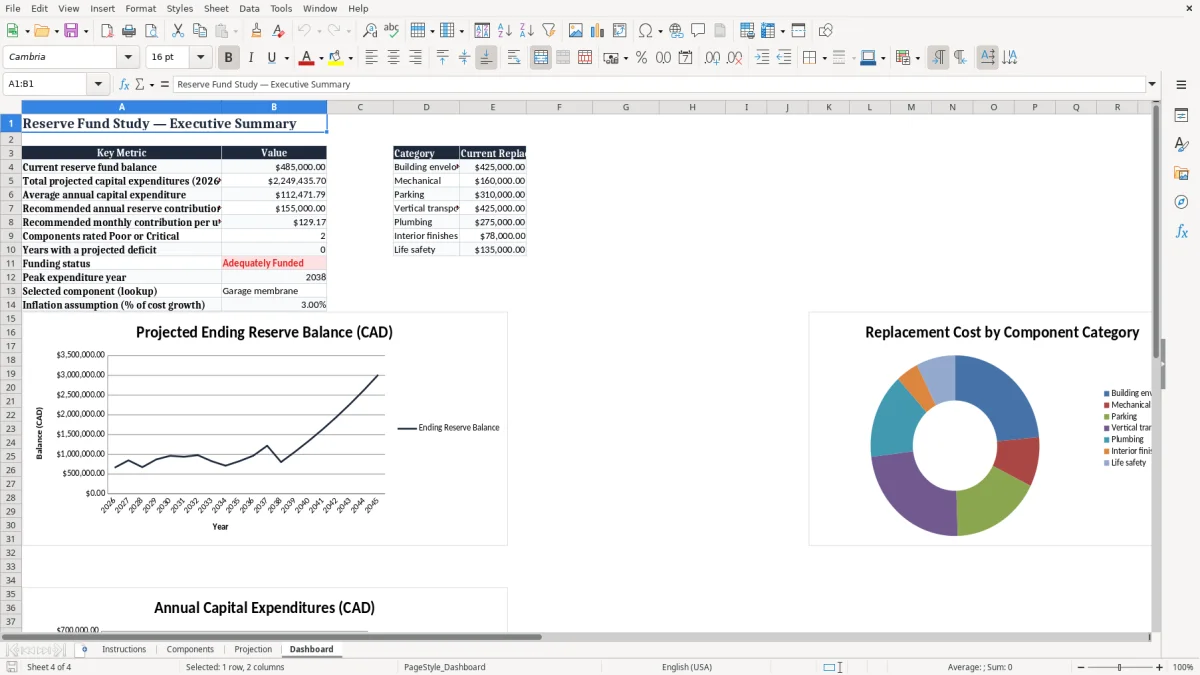
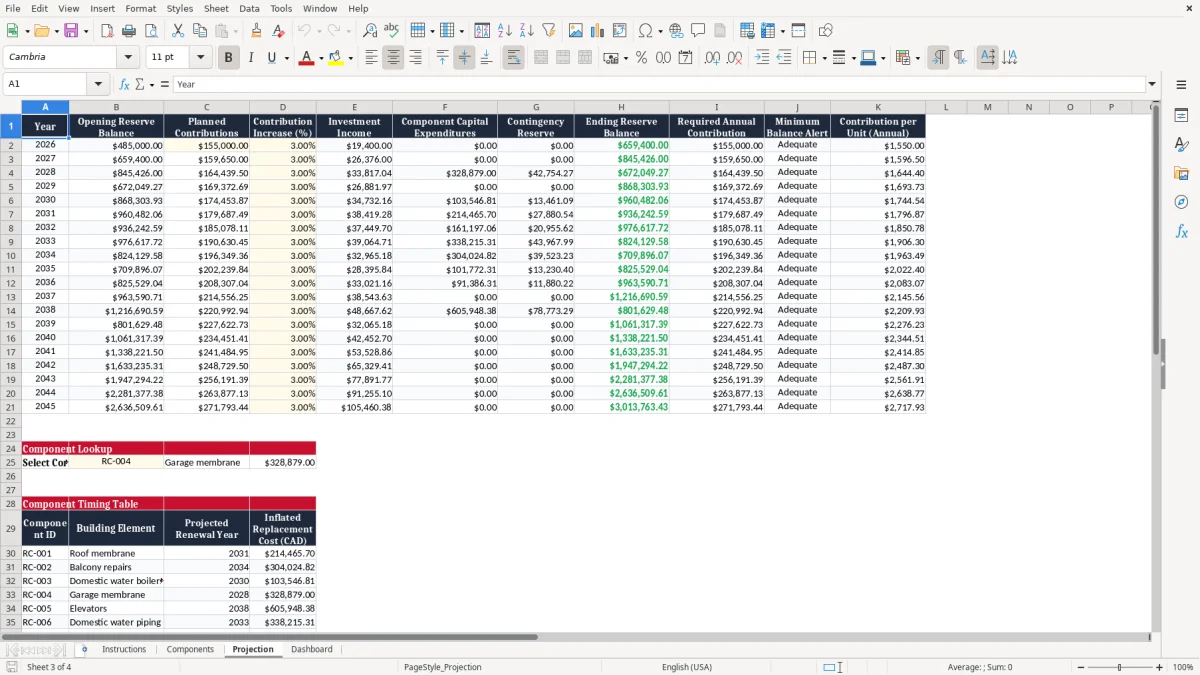
After entering components and assumptions, review the projected reserve fund balance across the forecast period. The model should show how planned contributions and investment or interest assumptions, if included, interact with major expenditures.
Pay particular attention to years with several large projects occurring together. A positive balance in one year does not necessarily mean the fund is adequate if important components are missing, costs are understated, or project timing is too optimistic.
Test reasonable scenarios rather than relying on one forecast. For example, compare a base inflation assumption with a higher construction-cost scenario, or model a project occurring earlier than expected.
Scenario testing can show how sensitive the contribution requirement is to component timing and cost. It may also help the board decide which information should be verified through inspection or quotations.
If the projected balance becomes negative or falls below the corporation’s preferred minimum, review the data before selecting a funding response. Confirm the current balance, remove completed work, update cost estimates, and check whether operating expenses have been incorrectly included. The board may then consider increased regular contributions, adjusted project sequencing where technically appropriate, financing, or a special assessment, subject to legal, accounting, and professional advice.
Use the workbook as one part of the annual planning cycle. Present the assumptions clearly, record decisions, update completed projects, and preserve historical versions so changes can be explained to owners and future boards. Do not use spreadsheet results alone to approve technically complex work or determine statutory compliance.
When the next season’s workbook turns to event scheduling, the bonspiel draw sheet keeps matchups and ice times organized alongside the annual planning cycle.